We asked our 2025-26 Accessible Instrument Development Fund grantees to document their journey towards creating a brand new accessible instrument. One of our grantees, Billy Payne, wrote the below blog to provide a detailed insight into how their instrument, The Pentachord was made!
Billy Payne & The Pentachord
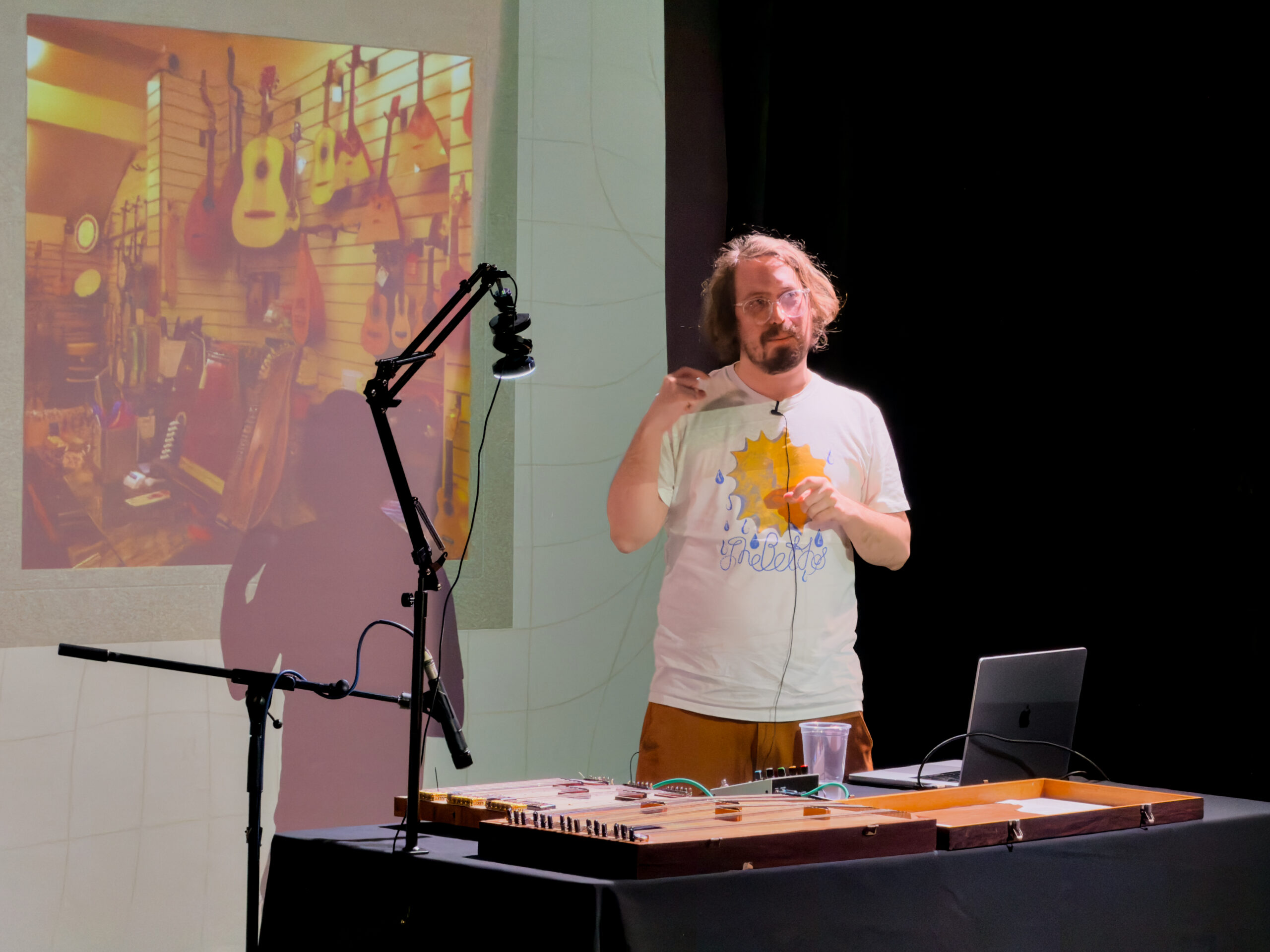
The Pentachord is, in a lot of ways, an unusual project for me. Much of my work, and most of the DIY accessible instruments I encounter, rely on technology to create what the designer hopes will be more accessible modes of interaction. I personally often use capacitive touch sensors as my main way of playing notes, then spend time thinking about how to lay those notes out in an intuitive or ergonomic way, and how to add motion or gestural control for expressivity. However, I quite often find that when I bring these instruments to group sessions with disabled children, what I think are cool, intuitive, incredibly exciting bits of tech get dropped in favour of something like a ukulele (yawn).
The Pentachord is a purely acoustic instrument, and one of the huge benefits of this is that, rather than building the tech first and then trying to layer expressivity and sound on top, acoustic instruments tend to have a built-in intuitiveness. There’s a kind of coherence that comes from a physical object vibrating and creating sound which is hard to replicate digitally.
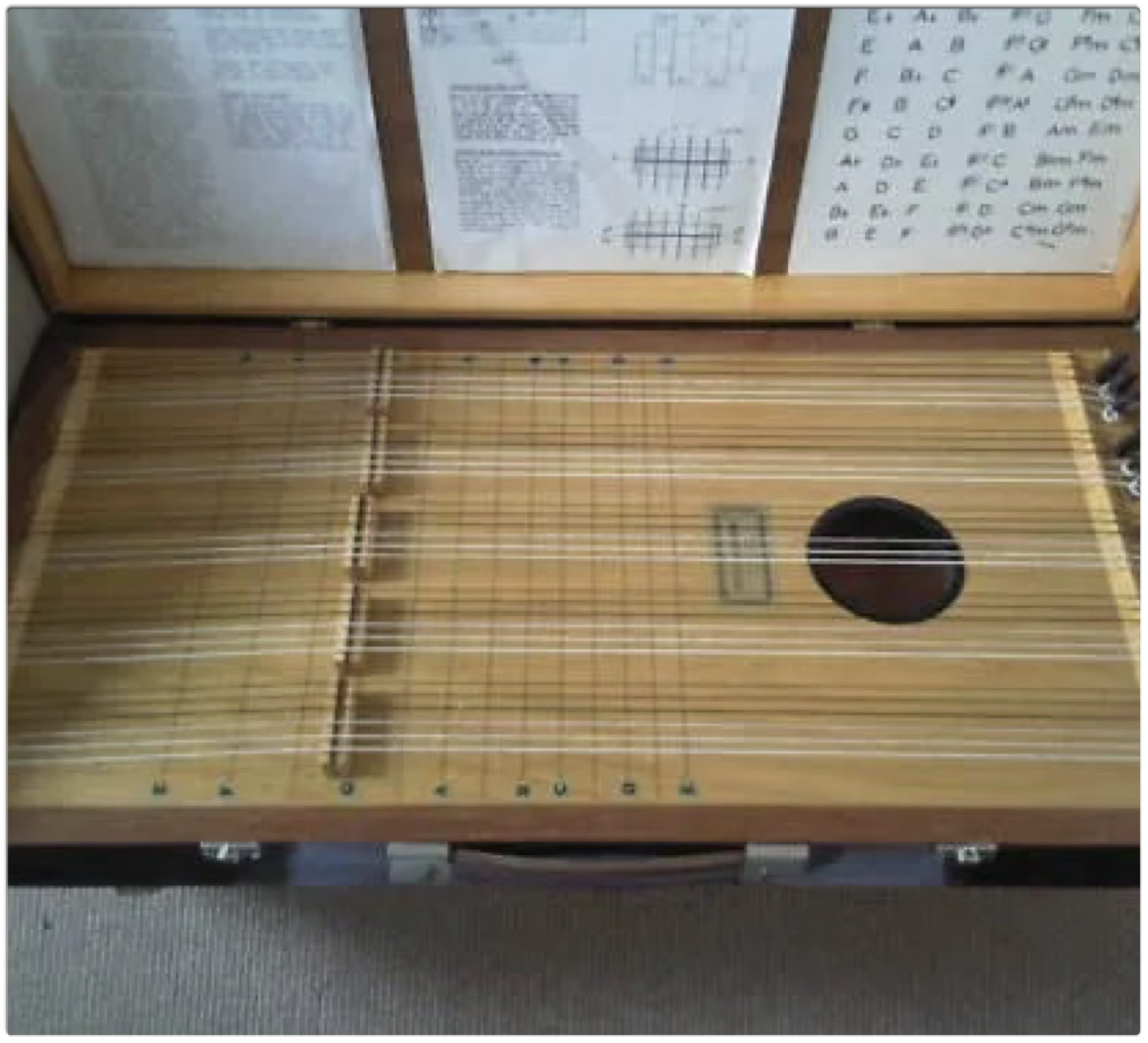
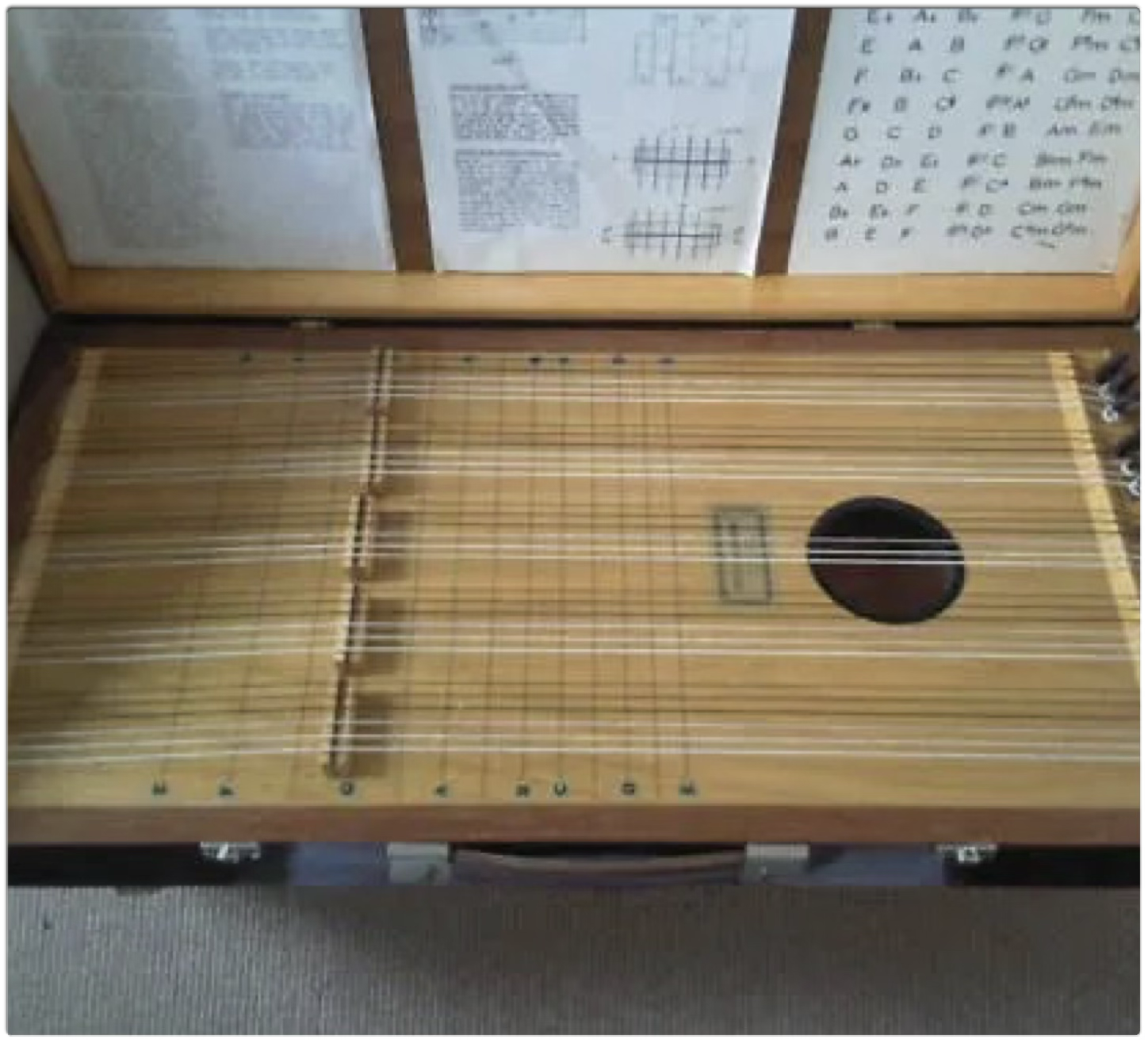
The other way in which the Pentachord is unusual for me is that it’s not a new instrument. It is, however, quite a rare one. It was designed and patented in the early 1970s but, from what I can tell, didn’t really take off. There’s very little information about it online, and good luck finding one to buy. I was lucky enough to stumble across one second-hand in a shop in Manchester and immediately snapped it up.
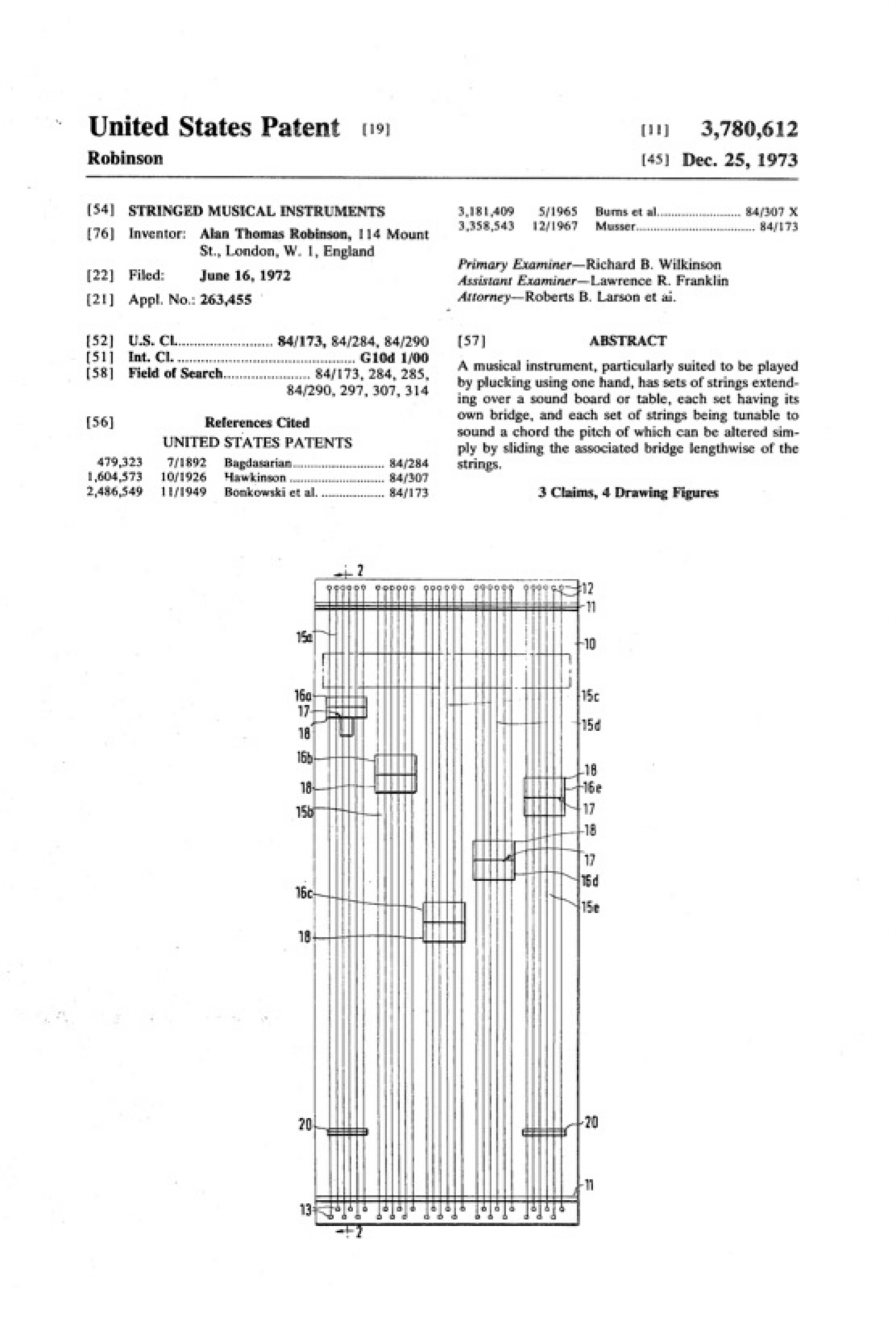
The Pentachord, as its name suggests, has five sets of six strings, each tuned to an open chord – a bit like five guitar necks laid flat on a box. Each has a movable bridge which works a bit like a capo, allowing you to change the pitch of the chord quickly without retuning. This means you can choose five chords for a given song and quickly change to five different chords for the next one. The usefulness of this in accessible music settings immediately stood out to me. The problem with guitars and ukuleles for many disabled musicians is the dexterity and hand strength required to fret strings. In community music sessions, I quite often tune instruments to an open chord so that strumming without fretting still sounds good, but this limits the player to a single chord for a whole piece of music.
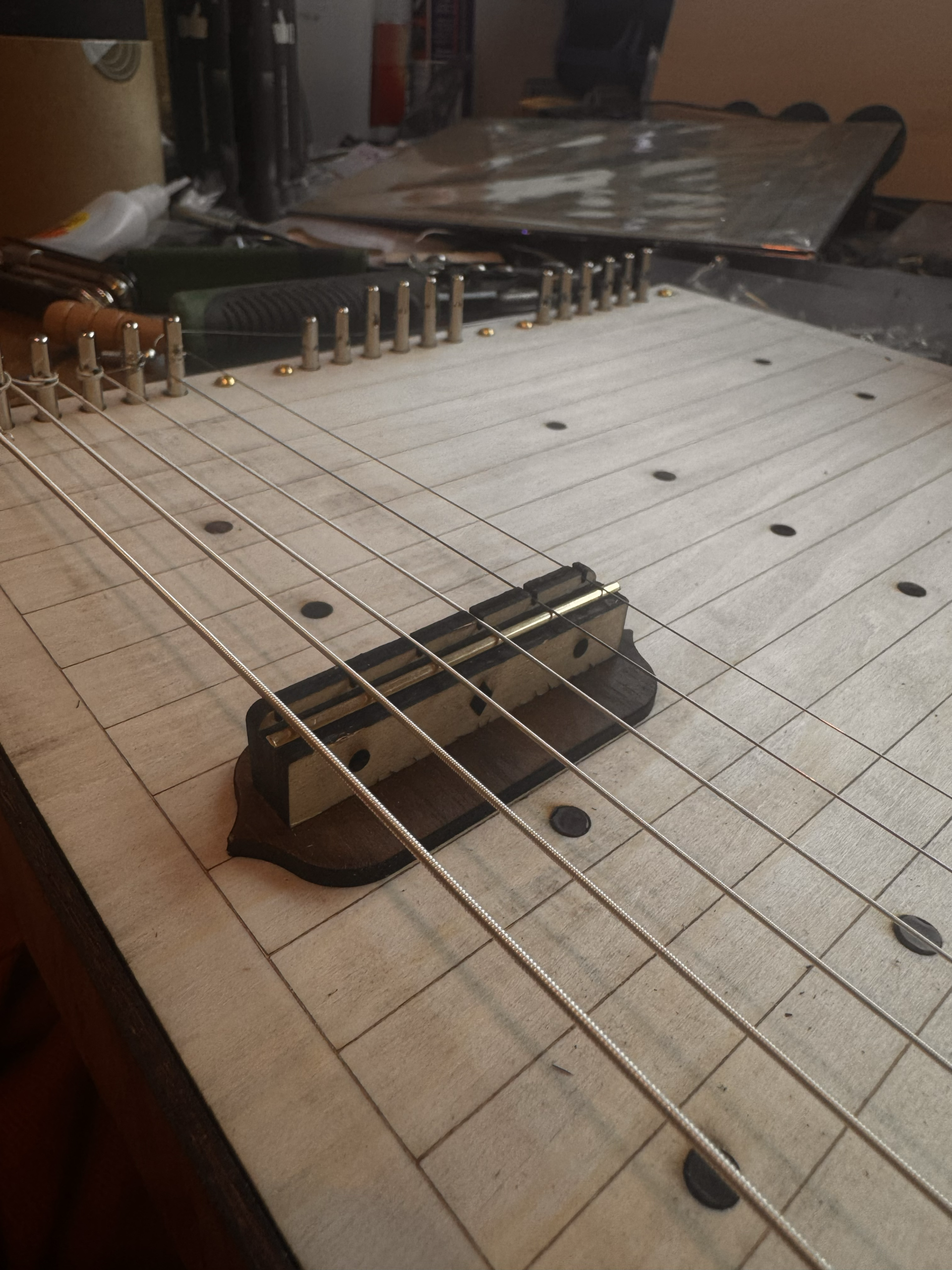
The Pentachord is such a neat solution to this problem that I immediately thought it must have been designed with disabled users in mind. I was really chuffed when I eventually found the original patent online and my theory was confirmed. I’m sure there were other instruments designed with accessibility in mind before the 1970s, but there can’t have been many. More than ten years before the first Soundbeam, the Pentachord feels like a small but significant piece of accessible music history.
I think a big thing for me is that making the guitar – the coolest of all instruments – more accessible is really important, and really difficult. You can see how many commercial, electronic, accessible instruments try to emulate some aspect of what the guitar is or does, and often miss something, partly because it’s so hard to get the sound, expressivity and method of interaction to feel like they truly belong together.
There are, of course, other strummy, chordal, acoustic instruments like autoharps and zithers which make chord playing much easier, but they’re quite un-guitar-like in how they feel and sound to play. To me, as a guitarist, the Pentachord is the closest I’ve found in the accessible instrument world to that feeling.
And because it’s essentially a lost instrument – almost impossible to find – it felt important to try and recreate it. I wanted to see if I could make one relatively simply, using modern digital tools and manufacturing methods that weren’t available in the 1970s, and then open-source the result as a way of keeping the instrument alive.
Building the instrument
Although the basic idea of the Pentachord is quite simple, recreating it turned out to be anything but. A box, some strings, and a movable bridge sounds straightforward, but getting everything to work reliably in practice raised a surprising number of challenges.
I was particularly interested in whether it could be built using laser-cut parts, both because that’s a process I use a lot in my own work, and because it opens up the possibility of making the design easy to replicate. The original instrument feels quite traditional in its construction – proper woodworking – so translating it into something that could be made by a non-woodworker from sheet materials was an interesting design problem in itself.
I also made things a lot harder for myself by attempting to only use 3mm plywood. A lot of lower-powered laser cutters can only cut up to this thickness, so the idea was that this would make it more accessible for others to build. However, so much of traditional instrument making depends on the properties of the materials. While we often focus on tonal qualities of wood for instruments, things like hardness (to hold metal hardware) and stiffness (to cope with string tension) turned out to be even more important here.
Another complication was that the laser cutter at my local hackspace was out of action, so I had to work on a smaller machine and make a smaller instrument. This meant that the margins for error in tuning and intonation were much tighter than they needed to be.
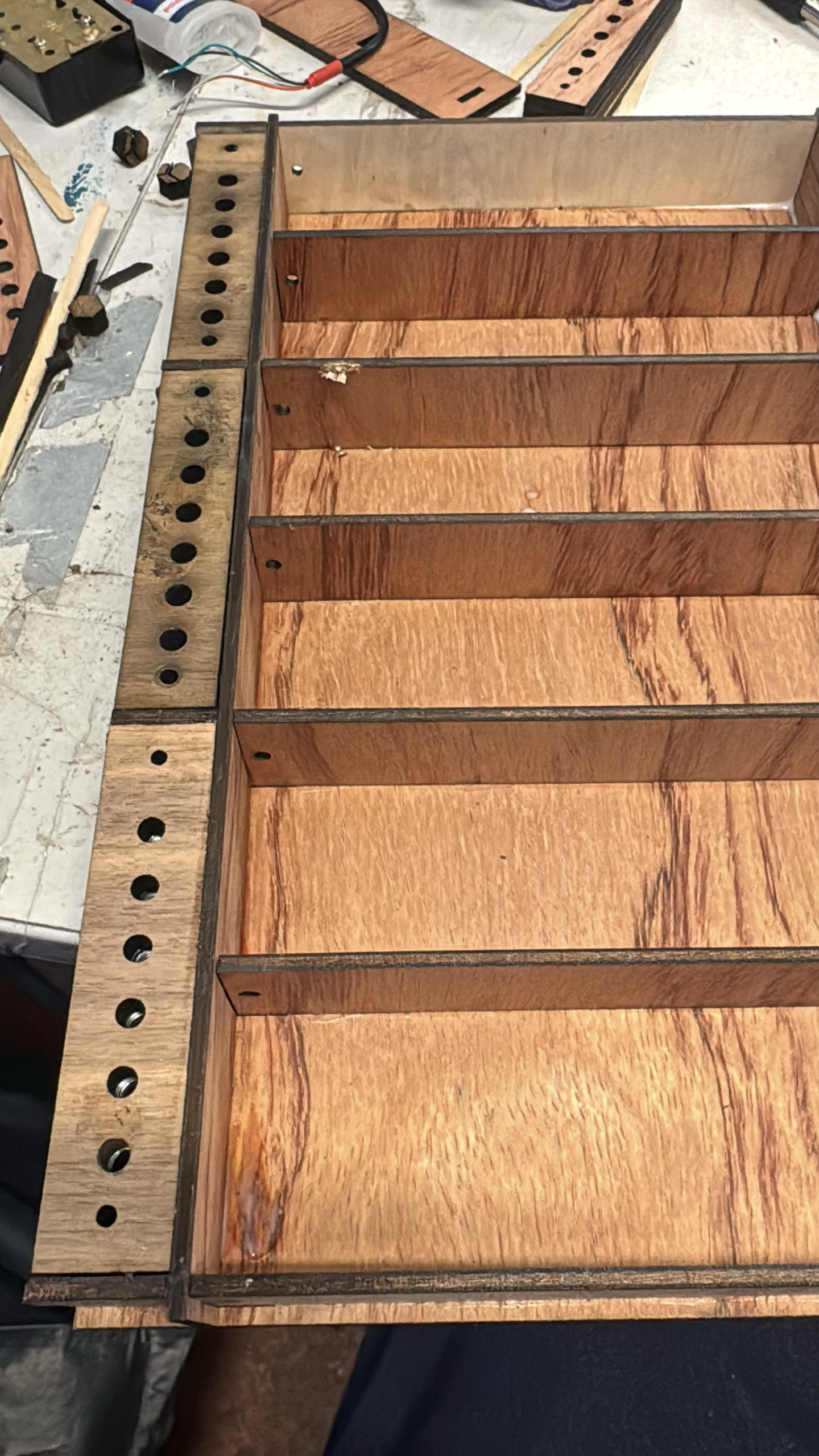
One of the biggest challenges was tuning stability. Because the instrument relies on relatively high string tension and multiple moving parts, small changes in the construction can have a big effect on how well it stays in tune. Designing something that was robust enough for workshop use, but still simple enough to build, involved a lot of trial and error.
The movable bridges (or “frets”) were another area that needed a lot of iteration. In theory they work like a capo, but in practice they need just the right amount of downward string pressure and positioning to get a clean, consistent sound across all the strings. Too little contact and the strings don’t speak properly; too much and the instrument becomes difficult to tune or adjust.
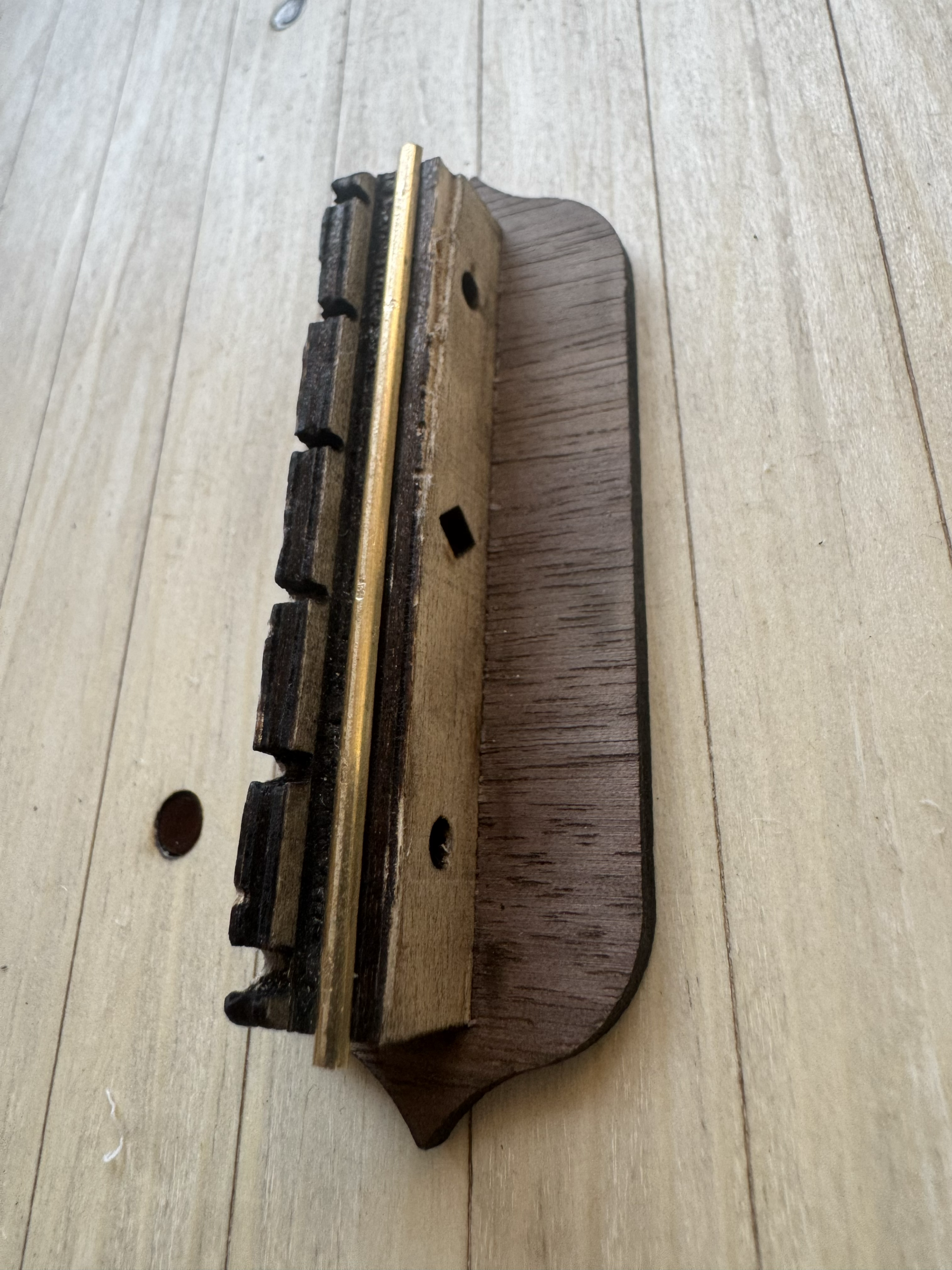
What I found quite quickly is that this is the kind of instrument where everything is connected. It’s an interesting mirror of building digital instruments: instead of trying to make independent elements (sound, interaction, expressivity) feel coherent, you spend a lot of time trying to manage that interconnectedness and make adjustments feel more independent. Changes to string length, height or tension all affect how the instrument feels and sounds, so the process became one of gradual refinement rather than solving one problem at a time.
One important aspect of the process was taking the time to learn Fusion 360 and create a parametric design. Parametric design (as in “parameters”) is a bit like design meeting algebra. Rather than working with fixed measurements, you describe how different elements (length, width, number of strings, number of supports, etc.) relate to each other mathematically. This allows you to quickly generate new versions of a design with different sizes and layouts.
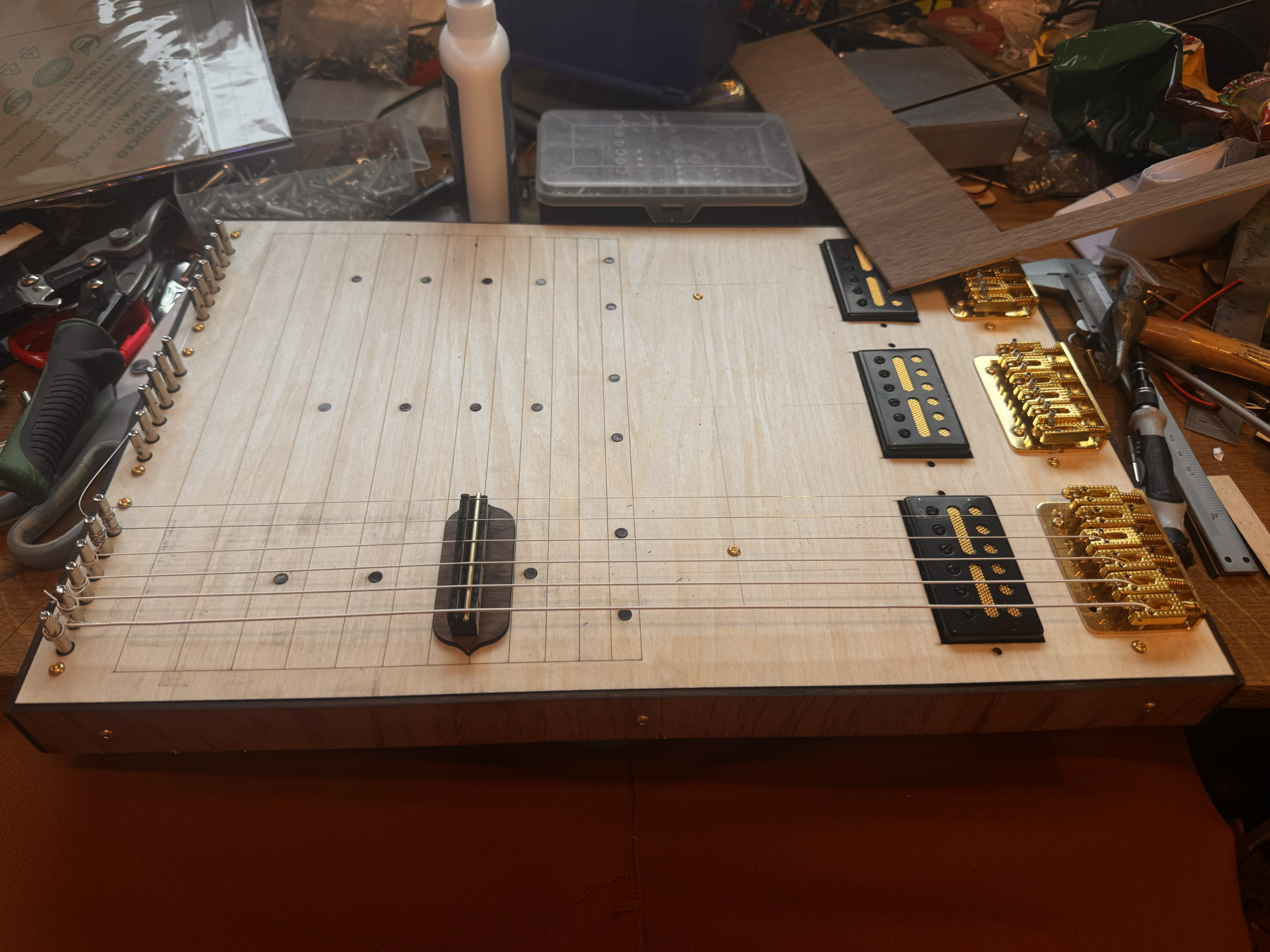
The final instrument I built was actually a Triochord – with three sets of six strings rather than five – but the design files allow for infinite variations. I felt this was important in making the project something that could be adapted, modified and improved by other makers over time.
Testing
The original Pentachord had already featured in quite a few of my sessions and workshops before I started the project, and many regular attendees had tried and enjoyed playing it – one of the reasons I was keen to make another. What was interesting, though, was how the changes I made affected the way it was played.
The main differences were:
- Steel strings instead of nylon
- A much shorter scale length (shorter strings)
- The addition of electric pickups
- Only three chords instead of five
Because of the reduced size and scale length, and some difficulty getting consistent contact with the movable bridges, the instrument ended up sounding less guitar-like than the original. Perhaps unsurprisingly, it sounded more like a smaller stringed instrument, such as a ukulele, and the lighter contact at the bridge gave it a slightly rattly, percussive, less sustained tone – a bit like a banjo.
However, the addition of pickups meant it could be run through effects pedals, and it turned out to be very well suited to fuzz and reverb – great for more ambient, shoegaze-style sounds.
At some point I started experimenting with using wooden rods as mallets, and found that this sounded beautiful and felt very natural to play. This approach was really popular in sessions, and several disabled musicians I work with quickly began creating lovely, unique, ethereal sounds.
I am a little disappointed that I didn’t quite succeed in making a more “guitar-like” accessible guitar, but I’m hopeful that future iterations could overcome some of the issues. Ultimately, I’m really pleased that the instrument worked as an instrument in its own right, with its own sound, techniques and quirks. One of the nice things about anything creative is that failed imitation often results in something new and interesting!
The Accessible Instrument Development Fund and the Future of the Project
The idea for this project had been knocking around in the back of my mind for some time. The Accessible Instrument Development Fund really gave me the focus to prioritise it, and to think in terms of a project with outcomes and legacy, rather than something I build and then never quite gets finished or shared.
Presenting the project at DMLab London was really exciting, and it was great to speak to so many people interested in instruments and accessibility. I’ve been involved with DMLab North-West in Manchester for some time, and I really feel these communities are invaluable for makers like me. I think quite often I have a tendency to get excited by an idea, work on it for a bit, and then get excited by something else and move on. Having something to work towards – even if that’s just showing it to a room of other makers – really helps me push through difficulties. I also find I feed off the enthusiasm and ideas of other makers and musicians.
Going forward, my priority is to make the project open source and to build a larger instrument which addresses some of the tonal and intonation issues with the Triochord. It’s already being used regularly in sessions, and that’s given me a good sense of where the design can be refined and improved. I would be really keen to hear from anyone who is interested in having a go at building their own.
– Billy Payne